


Drooms CEO on longer deals, data sovereignty and running AI in-house
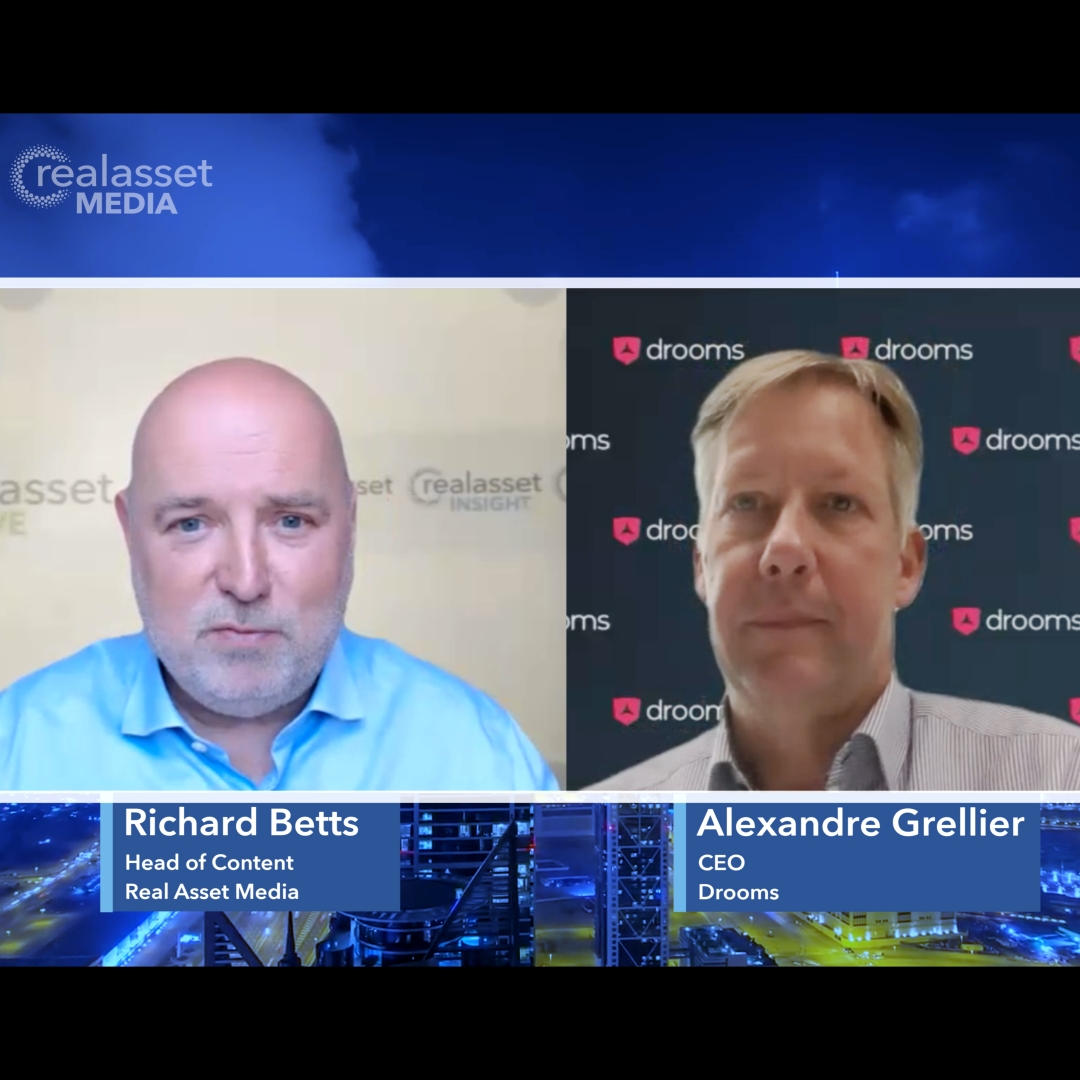
Drooms CEO and co-founder Alexandre Grellier on why M&A deals now take over a year to close, why digital sovereignty (where data lives and who owns it) has become a defining issue under GDPR, and why Drooms runs its own large language model in-house rather than sending customer data to public AI tools.
- Drooms research shows deal durations rising to roughly 368 days on average.
- More complex financing and deeper documentation demands are lengthening deals.
- Digital sovereignty is about who owns the data and the company holding it, not just where it sits.
- Drooms runs its own LLM on its servers rather than sending customer data to ChatGPT, Claude or Gemini.
- AI improves efficiency but is not yet reliable enough to base decisions on.
When the head of a data room company talks about the market, the numbers tend to be self-serving. Alexandre Grellier, CEO and co-founder of Drooms, gave Real Asset Media something more concrete: his own platform's data showing that deals are simply taking longer to close.
“Where is my data going? And for us it's even worse, because we have to ask where is the data of our customers going?”
Alexandre Grellier, CEO, Drooms
Drooms' research puts the average deal at more than a year, around 368 days, and Grellier does not see it falling yet. The causes are structural. Financing has become far more complex, banks are asking for far more information, and the volume and depth of documentation flowing through the data room keeps growing. More information, more scrutiny, more time.
“If the company holding your data is not an EU-based, EU-owned company, it's pretty difficult to comply with GDPR.”
Alexandre Grellier
The more striking part of the conversation was about data. Digital sovereignty, Grellier argues, is no longer a niche compliance footnote but a defining question, and it is not only about where data physically sits. It is about who owns the company holding it. If that company is not EU-based and EU-owned, he says, complying with GDPR becomes genuinely difficult.
“People believe sometimes there's magic coming, and there's nothing magic. We're talking about large language models, predictions. They can be right, they can be wrong.”
Alexandre Grellier
That logic extends to AI, and it is where Drooms stakes out a position. Public tools like ChatGPT, Claude or Gemini do not hand over their source code, so they cannot be run inside Drooms' own environment, which means customer data would have to leave it. Drooms' answer is to run its own large language model on its own servers, compliant with the laws its clients operate under.
Grellier is unromantic about the technology itself. AI helps with efficiency and produces strong results in parts of the business, but it is not reliable enough to build everything on, and it is not magic. For a buyer weighing Drooms, that combination, EU ownership, in-house models, and a candid view of AI's limits, is a concrete answer to the question every dealmaker should be asking about where their most sensitive documents and the models reading them really live.
A clear differentiator for security-conscious dealmakers: Drooms' EU-owned, in-house AI stance directly addresses where sensitive data and the AI models touching it actually live.
I'm joined today by Alex Grenier, who's CEO of Drooms.
Alex, thanks so much for joining us.
It would be good to get your sense of where we are here in terms of the market.
I know you've done some research as well in terms of the trends.
So I guess, what are you seeing at the moment?
We did a research by the end of last year, which is interesting that the duration of the deals have been increasingly taken more time.
And so we are at a highlight of more than a year.
By the end of the year, there was a stop.
So it was like we are now at 360 something, 68 days in average.
So first people were talking about that could be a turning point.
This could be light at the end of the tunnel.
What we We had more deals which were in preparation, which we're trying to get over the line, but this hasn't materialized yet.
So there was a little bit more, the first quarter, 2026, but the duration hasn't really gone down yet.
And a couple of reasons could be the financing side, which has become far more complex.
Banks are requiring far more information.
I see it as well with regards to the volume that we have in the data room that we are hosting, where we see increasingly more need of documentation, deeper documentation.
The volumes globally become bigger, but it has been more dedicated information which have been required.
with regards to more information, more information, more information, so that globally deals are taking much longer.
So what I hear from the market is that the bid -ask gap is not exposed.
You're also looking, obviously, from a tech perspective, keeping up to date on those kinds of things.
How are you seeing aspects like digital sovereignty, AI, those kinds of elements?
and how they're going to be influencing, I guess, what you're doing, but also what we'll see in the market here in Europe.
Digital sovereignty has become a major topic.
So as you see more and more software using AI, AI per se is very good.
It's very helpful.
It helps you to really streamline your processes, get faster, get better and faster results, not always better, but most of the times.
The question that you're asking yourself is, where is my data going?
And for us, it's even worse because we have to ask ourselves, where is the data of our customers going?
What kind of data do we have on our platform?
And so digital sovereignty is a key topic.
And digital sovereignty doesn't just mean where does the data lie.
It's really who is the is the data It's like if the company who is holding your data is not a EU -based company, a EU -owned company, it's pretty difficult to comply with GDPR.
And so this is one of these challenges.
And now if you turn it into AI, and this is where we are all really working hard on and getting really good solutions for our customers is like who is owning the models you are.
Then I'm using to analyze data to analyze content you know and if you don't own it if you just don't run it on your platform which for instance with.
These solutions that you know like Claude, Gemini, ChatGPT, it's just impossible because you're not getting any source code.
So you just cannot block it on your platform.
Then it becomes really, really complicated to work with.
There's always a challenge.
Do you want to stay in line with the law or do you use all the publicly available tools?
And so have a large language model which is running on our servers, which is really compliant with all kind of laws that you would need to be able to use these tools.
So it's complex, but it's an interesting journey.
Where do you see that landing?
Alex, do you think it's going to make a significant impact?
Are you already seeing that impact?
How do you see that developing for the industry?
The impact of AI is undeniable.
Do we really see business models changing due to AI?
Not yet.
Is AI reliable AI reliable to a point where you would just base everything on AI?
Definitely not.
At least not yet.
But it really helps making you more efficient.
It definitely helps getting really good results in some parts of the business.
And this is the thing.
People believe sometime that Magic which Magic which is coming and there's nothing magic.
I mean we're talking about large language models.
We're talking about predictable predictions and stuff like this.
They can be right.
They can be wrong.
So you really need to put the system in place, which is not hallucinating too much, which is providing the right results.
And this is this is complicated.
with the laws.
It's a very interesting topic, I think.
And just in terms of, I guess, what you're seeing coming seeing coming through the data rooms, you mentioned there that there's that there's been a pickup in terms of some of the transactions that you were seeing.
Are you still seeing that?
Are you seeing a sort of a more positive trend in terms of the market at the moment?
That's a very difficult question.
Actually, I would have said yes a couple of weeks ago.
Now, with the global economic situation in the world, with the wars that you see, I want to say that there is a lot of things, again, being postponed.
And so we all want to see new positive impulses.
But today, it's a very narrow plan.
It's really interesting to catch up and get your perspective, Alex.
Thanks so much for joining us.
Thank you very much.
Auto-generated transcript, may contain errors. Listen to the original to confirm wording.
Summary and analysis by VirtualData-Room.com from the public episode. Play it above; the original source is linked there.