



Extend Women in Tech: Kristina Devochko, Microsoft MVP and Software Architect at Admincontrol
A conversation with Kristina Devochko, a Software Architect at Admincontrol and a Microsoft Azure MVP, on cloud-native development, cybersecurity, and DevOps. It is a window into the engineering and security culture behind the Admincontrol platform.
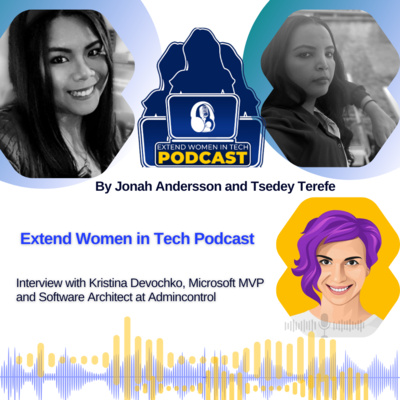
- Kristina Devochko is a Software Architect at Admincontrol and a Microsoft MVP for Azure.
- The discussion covers cloud-native technologies, Azure Kubernetes (AKS), cybersecurity and DevOps.
- It signals that the Admincontrol data room is built and run on modern Azure cloud infrastructure.
Useful for buyers who care about the engineering and security depth behind the product, not only its features.
When I was studying at my last year of the bachelors, I started applying for different jobs and I came in into a company as a trainee and they were working fully with the Microsoft tech stack.
So they had applications that were written in .
NET and C# and then they at that point have just introduced their cloud.
on Microsoft Azure.
And I started as a full stack developer, but mostly working with the backend.
So my knowledge of Java came quite handy in because it was, there are quite many similarities between Java and C#.
So the transition was relatively smooth.
.
This is Jonah Anderson and here with me is Chedi Terafi, my co-host on this podcast.
In today's episode, we have a guest from Norway, Kristina de Richkoff, an expert in software architecture with proficiency in cloud technologies, cybersecurity, DevOps, and with the recognition of being a Microsoft MVP.
is over 8 years of experience and has been involved with several tech projects in the public and private sector.
She has also built and deployed several projects.
Today we have the privilege of delivering into our guest's unique career journey which has been taken from her being a social economist, diplomat, interpreter to a successful technology professional.
We will be exploring how she transitioned into the tech industry and what led her to make this change.
Let's give a warm welcome to Christina.
All right.
Hello, everyone.
Thank you so much, Shedi, for giving such a nice introduction for me.
And thank you and Jonah for giving me the opportunity to contribute to Extend Women in Tech podcast.
to our podcast, Chris.
Do you prefer Chris or Christina?
Chris is fine.
I feel like Christina is very, very formal.
Like when I did something at home when I was a kid, I wouldn't be like Christina.
So Chris is fine.
Yes, that's great.
Yes.
Welcome to our podcast and thank you for contributing.
I know that you volunteered to be our guest and you were the first who responded to our new CFP.
.
We are happy to have you here with us this year on one of our episodes.
So, Christina, or Chris, tell us more about yourself, aside from what Shady have introduced.
Is there something else that our listeners need to know about you that's interesting?
Yeah, I think Shady has given a very good introduction of me.
Just maybe to clarify, I think that I haven't been working as a social economist or diplomat or interpreter.
These were like the roles when I was growing up that I was thinking I would end up working with.
And then it ended up in tech, which I am very, very grateful for that it did.
So on the personal note, I guess, those who have been me and my presentations in the community and at work have seen that I really love cats and I like mentioning that fact everywhere.
That's a big part of my life and kind of the way I structure my content and make it a bit more entertaining.
So on a personal note, I really am.
I love animals and have two cats at home.
.
When you were awarded for the first time as the Microsoft You did your first public speaking virtually at our user group, Azure User Group Sweden.
So Hoke and I hosted your session.
And I do remember that you had your demo with cats.
And then you had your cat look as well.
So it's pretty obvious that you love cats.
Yeah, you did mention about the journey to tech.
.
So, Shetty and I are curious about how you got into tech and where you are right now, especially in the field of, like, I know that you talked a lot about, of course, not just cats, but also about Azure Kubernetes or AKS or container developments a lot.
Can you please share about that?
Of course.
Yeah, so I am one of those women who was not planning to end up in tech to begin with and haven't even .
As I grew up, I had a really big interest in foreign languages and that was kind of a natural thought I had in my head that I would be probably an interpreter working with translation services, working with foreign languages in some way.
Diplomat was also kind of a potential career journey that could have been for me because it's also tightly connected to working in a more international .
And that's what I lived with for some years.
But then coming from a rather small city in Ukraine, because I have been living in Norway, but ethnically I am not Norwegian.
So there weren't many opportunities that were so easy to start with in that field, especially if you didn't have a broad network of connections and people who could help you there.
and that's why I was not sure where to go after high school.
So the closest I came was a study program that was called International Economics.
And I started studying there.
And after the first year, I actually came in to the University of Oslo.
I got accepted because I just took a chance because we knew some of the relatives who were living here in Norway and said a lot of great things about it.
And then I ended up studying economics at the University of Oslo for 12 years ago.
And I need to be honest here.
And I found it extremely boring.
This was so, so, so challenging to go through that first year.
I really felt like this was not something I enjoy.
with it was really scary.
And so I started working in the restaurant as a part-time job on the site for my studies.
And there I got to know a really good friend of mine, a female who was studying informatics at that point.
And she was talking a lot in a positive way about how the good atmosphere is there at those studies.
the studies how interesting the subjects are and she really enjoyed going studying in the program and she just challenged me at some point like why don't you try and reapply and switch the study program and see if that would work out and I thought why not I mean I had some informatics subjects as part of the economic studies and it was going quite good I enjoyed it it was with pure HTML more or less.
And still, I felt like it was really interesting.
And I was also helping often with fixing devices at home for my family and relatives.
You know how it is when you work in IT.
This is even more of an expectation.
So I thought, like, why not?
Let's try that.
in programming and networks at the University of Oslo.
And then that's how my journey started to tech.
And if I would be honest, it was not just unicorns and butterflies at that point.
It took me several years before I found the spark, before I was actually able to realize that this is what I enjoy 100%.
.
And I was the switch was drastic, like from going from knowing more or less nothing to suddenly start studying operating systems, studying C, studying Java, understanding the difference between object oriented programming, functional programming.
And then you have really short period of time to understand the topics before you have exams coming up and mandatory tasks that you need to deliver.
And I was not always lucky.
with kind of having that chemistry with the teachers and kind of really understanding what kind of information they were trying to explain so I really struggled the first half of the studies I really struggled to figure out where I belong and then at some point I found a study partner also another great woman that I am talking to on a daily basis now and we we really enjoyed like every day it became a routine we just came together and took a room and were sitting and were brainstorming things and doing all those tasks and exercises together and I think this is what kept me going because I felt that I was not alone at some point in this journey and I am thankful that this worked out like that I found support in other women in also trying to figure out their place in tech.
And it was back in 2013, 2014, and we were not many female students there.
That was really visible.
And this was also, like, I know it sounds like it's very popular these days to discuss this, but it It does have an important meaning that we have a lack of female programmers, of female in tech.
And I'm also coming from the culture where this is even harder to accept than it is in Europe.
So I really see that the change is very important and it is visible.
We can see more female now.
I can compare with how it was back in 2013.
So that was great.
That's how I ended in tech.
Yeah, that was really an interesting story that you shared and it was like amazing that it started at you working in the restaurant and then your female friend referred you to study more development and programming in the university.
And then in spite of all the challenges that you have, .
We have another friend that you could pair programming with who was also a developer.
And I personally can relate how it is years ago as well around that time frame or years.
I also, like, studied Agile System Development and .
NET here in Sweden.
And I can relate to how it is in Irkesugskula, we call it in Sweden, where in a programming class there are only, like, to three women or female students.
And it's really obvious the imbalance in there.
So I'm glad that you conquered your challenges.
And we are both here speaking and inspiring others about our tech journey.
What do you think, Sherry, about the story?
Yeah, it's so inspiring.
Thank you for sharing.
And then I like the part that you got the challenge from your friend and accepted that one and then and that's a big decision to take in life because you are totally changing your career paths and then you trust i believe you trusted her in that way okay let me try you know such kind of mentality that's uh i think brave of you go ahead and then work that part yeah yeah i think i wouldn't i wouldn't even think about it if she didn't challenge me and then and I was like watching and observing the way she was talking about it and I was at some meetups together with her at the university she just took me there just to take a look to get the feel of it and then that made me more that made me safer to maybe take this decision because as I mentioned I came in with a mindset from the culture where I grew up where I often used to hear that : A female's place is in the kitchen, you know, and this is basically a quote.
And it really triggers me, but I feel like it's important to share this, that this, I guess, also what I'm doing now is to prove the opposite, because this needs to stop this, this mindset needs to stop that women are not smart enough to do, to work in technology.
mindset, only the way people were thinking at that time, you didn't have much of a choice and having someone who could challenge you otherwise is really valuable.
Yes, that's really great.
So a developer is a skill, it's not actually a gender.
So if you're a developer, you're a developer, you'd solve and build things as you are, .
through this talk or conversation as well.
I just want to ask, do you have any kind of moment where you said, I shouldn't take that path?
Were there any moments like that after that you decided?
Oh, I've had many moments.
I've had many moments after I changed the path of when I started studying because it was really challenging.
.
And I kind of also want to be transparent about it so that it does not give an impression that it's just that easy.
The reality is that for many it may not be easy.
So I had many nights where I was trying to complete, especially in the beginning, especially before we started having this brainstorming with a friend of mine, when I had subjects that we didn't have with her where I was on my own.
In the beginning, there were many nights where I was trying to complete these tasks and I was really struggling understanding that.
And I was thinking like, what the hell am I doing?
Maybe this is all a sign, you know, a sign from a destiny, a universe trying to show me that I'm not made for this.
I tried to do my best through tears at that point.
I just did my best what I could to deliver.
And then coming through that challenge by challenge, like not giving up ended in me being where I am today.
And I think looking back, I'm happy that I didn't give up because I thought, okay, until I am getting through this, until I am able to continue, I can relate to the challenges.
.
.
So in that first episode, when I was a guest years ago, I was not an MVP yet then, but that was the chance I had to share about my tech story and journey as well.
So definitely can relate on the challenges and making baby steps and not giving up.
.
.
or we met virtually, but I was happy, very happy that, uh, I believe it was, it was recently last week, a few weeks, uh, from the time of this recording, we did meet at a sweet conference.
Yeah.
So it was a really great, uh, to, uh, to be in the conference with you.
And, uh, I know that you did attend my session, which was about a, uh, Azure, uh, IOT development, uh, .
That was great.
And I also attended your sessions.
We attended each other's sessions.
But I know it was also your first time at Sweden.
So can you tell me more about Sweden and your experience as coming to Sweden to speak at the conference?
Yeah, I think that was really great to meet you in person as well.
And I also got to meet multiple members of the tech community, which I only knew.
on the social media so meeting meeting you in person and talking to getting to know you more as a person was also really really great and this was not just my first time at sweet took but it was also my first time being a speaker in person at a conference that is like larger than meetup because until now i was mainly speaking at meetups and user groups and i was speaking in person at some user groups here in Norway, but I wasn't speaking at a conference previously.
So this was, this was very exciting for me.
And it was like a new challenge when it comes to stepping out of comfort zone and just standing there in front of, in front of many people and sharing the knowledge.
And I think that went really well.
And I feel like the conference has been great with a great , great speakers, very interesting sessions.
And also the way that organizers have made this a smooth experience for me as a speaker was really helpful, especially this being my first experience in such a setting.
So I think this was a huge enjoyment.
And I also took train to Stockholm this time from Oslo, five and a half hours.
So I really enjoyed it.
I really enjoyed it.
That was a great way to be productive and doing some some tasks while having this amazing view out of the window.
So that was also a really great experience, actually.
Yes, that's really great.
I'm very happy to speak in a conference where it was also your first time in-person conference.
So we supported each other there.
Thank you.
It was a great session you did.
So it wasn't so obvious that it was your first in-person big conference.
So congratulations for making it.
.
And yeah, it was fun.
And in there, we met also another MVP, Asher, a female MVP, Marilag, I think her name is Dimatulak.
She's also, just as a background for the audience in Shetty, there are only one female Asher MVP per country in the Nordic.
So I'm the one from Sweden.
Christina is from Norway.
is from Denmark.
So when we met each other there at Sweden, we were so I was like, I had this idea.
Oh, this is like, like, the three big women in the community that needs to have a picture together.
And we were like sharing the entire after party, like about our journey, a lot of things about work and consulting.
And that was that was awesome.
So yeah, it was a good, a good .
Congratulations to you both.
It's a big moment, I believe.
Yeah, it's just a very special moment.
Yeah, but how do you, Juna, let me ask you, how do you, how do you find the Sweet Hug?
Yeah, it was great.
Just like Christina mentioned, it was actually my second time speaking at Sweet Hug, in a sense that I spoke in Sweet Hug Gothenburg, .
But first time in Stockholm.
So it's a bit bigger than in Gothenburg.
But I did enjoy the experience.
It was my first time to share about Azure IoT.
Chris was there.
So I went over time, to be honest, because I was like really interacting with the audience.
Hey, like about my IoT talks.
But it went great.
It wasn't so bad.
And I really appreciated the people.
me and other speakers like Chris joining there and supporting me.
And one of the things that I liked during my session at Sweet Oak was one of the audience, a young woman, came to me before I started and she said, hi, Jonah.
And then she looked familiar.
And then I remember that years ago I was a mentor of Datashay.
and she's there at the conference listening to my session because she now works as a software developer so I was happy to mingle with her quickly and she was there so great so cool yeah what do you say is a standout moment from this conference for both of you or what do you what do you say are the key takeaway I can start I think what I like about this conference or any in-person is for me three, actually.
Three key takeaways.
First, I get to, like, express or share the knowledge that I can share to the audience or the community.
Second is communication or getting to mingle with other speakers.
Like Christina said, got to meet other friends in the community in person.
And then third is being able to connect to the audience in pretty casual and laid back level that you don't see the difference hey i'm a speaker i'm the audience but you really feel the balance inequality there in terms of audience speaker and even the organizers and those are my key takeaways that i like how about you chris yeah i share a lot of your takeaways i think jonah so i guess the the biggest takeaway is having that opportunity to meet people that you don't meet that or you talk a lot to online.
But then having that discussion in person is a totally different experience.
And I really, really enjoy it every single time.
So I think this is like the biggest highlight.
And for me, especially in being a speaker, for me, the feedback and some response from the audience and those that actually take the time and come to my session in order to learn.
something for me.
This is also a very giving opportunity to get that feedback, to have discussions about something that I'm working a lot with and am passionate about and meeting others in the audience who share the same passion and then discuss in more details around the topic is also really giving.
And of course, being honest, I do love hearing that people find it useful and interesting.
I was talking about .
NET templates and how you could create custom templates in order to reduce the cognitive load on developers to create some blueprints that you can use to speed up your software development processes.
And I was talking to a few of the participants afterwards and they were like, oh, I was thinking about it so many times, but I haven't tried it yet.
And now I can, I feel like I know it.
I feel like I can go back and just try it out.
.
And this feels so good, like getting that feedback from the others who find it useful because that's why I do it.
I share the knowledge because I want to help others to maybe help them use much less time to achieve the same things that I have used more time on achieving myself.
So that is definitely a highlight.
And the third highlight is like meeting, listening to other speakers, , but also in person and maybe taking the challenge of going to sessions about topics I don't work with on a daily basis.
Like I was at your session, Jonah, which I think you did great.
And I haven't been working with Azure IoT at all.
So I think that was a lot of fun to learn, to learn more about it and how it can be used.
And also I was at a session about algorithms with tests.
And that was also not something I normally on that level.
So that was also a really interesting session for me.
Yes, I did attend that session as well.
And then the GitHub, some tricks, the things that we don't know, I was also in there.
Yes, it was great.
So I know, Chris, both you and I are moderators or volunteers at Streaming Clouds.
.
I know that it's a community that we volunteered and started.
Since you were a guest, do you want to share about streaming clouds to our audience in Shetty?
Yeah, I can share a bit.
Now I don't remember when this started.
It feels like I've been there for a long time.
But it all actually started by me just getting to know Robin.
, who is also an Azure MVP, but he is based in the Netherlands, and we were chatting a lot, and then I just applied to have a talk about Azure DevOps environments and how you could use that for deploying microservices to AKS, and we had a great session there, and I really loved the atmosphere, and Robin just suggested, like, would you be interested in moderating?
We have this Discord server where we want to bring community .
And that's how I joined.
And also found out that you are a moderator there as well, Jonah.
So now I think we are like almost 300 members and growing and counting.
And it feels like a really cozy place where you could ask about all things Asher.
And not only Asher.
and also talk about all things cloud.
This does not necessarily need to be Microsoft technologies.
And we have community calls where you could also join.
And I feel like it's, it became a really cozy and inclusive tech community where everyone is welcome.
Yes, that's great.
Yes.
So Shetty and the audience, if you're interested about having a virtual community, I also recommend streaming clouds to join.
.
Both Chris and I are moderators.
I haven't been active as moderator lately because I have Discord login problems.
But yeah, I do.
Yeah, I'm not so good with Discord.
But feel free to join the streaming clouds.
I believe the community is both on LinkedIn and Twitter.
So any questions related to cloud and learning from the experts are also hosted as events.
in that community.
I know Kristina that you're also a co-organizer of Norwegian .
NET user group, right?
You're everywhere, like me.
Everywhere, yeah.
So you also help with the organization of .
NET community events in Oslo.
Yeah.
Community.
I enjoy being part of the tech community.
So I'm doing a different, a few different roles.
So I'm a co-organizer there, as you mentioned, Jonah, and I'm also a co-organizer in Cloud Native and Kubernetes Oslo community as well.
So, and recently in DevRel Oslo.
So like trying to bring that community in Oslo especially closer.
I think that's very giving.
I think if Sherry might be thinking right now, .
How can these two gals have the passion to do a lot of stuff?
And I was thinking exactly like I remind readers sometimes.
And I think the answer to that, Shady, it's because of our passion for community.
And also, I believe you have the same purpose also, Chris, like based on our background and challenges in our journey to tech.
I think what drives us and what makes us passionate about what we do here and there in different communities, .
It's how we make this impact to others and inspire them and help them through our talks.
Like what you said, Chris, like someone after a session at Sweden approached you that, hey, your session was really great.
It really helped me.
That feeling that you have helped someone or at least gave them an inspiration and insight, that is kind of like filling the cup that drives us.
Continue what .
and being the good role models to others in tech is what drives us, all of us that are here.
I know you also, Chetty.
So I have a question.
Now we're going to go into deep dive into your tech experience.
So can you tell us about, I mean, I know that you studied programming and you learned a lot.
You did mention you have to learn the basic about the difference between object-oriented programming to functional programming, for Java, you also learned that like I did.
But can you tell us about your journey to .
NET, cloud computing, and how did you get started working with container development with Azure Kubernetes Service or AKS?
Yeah.
Yeah.
So when I was studying at my last year of the bachelor's, I started applying for different jobs.
in into a company as a trainee and they were working fully with the microsoft tech stack so they were they had a applications that were written in in dotnet and c sharp and then they at that point have just introduced their cloud offering on microsoft asher and i started as a full stack developer but with the backend.
So my knowledge of Java came quite handy in because it was, there are quite many similarities between Java and C sharp.
So the transition was relatively smooth.
And I, but I was, haven't been working with big enterprise code bases before and coming after studies has been quite, quite a challenge as well, figuring out, okay, I have an issue here, a problem that I need to solve, but I also have this, with millions of lines of code and lots of dependencies.
So where do I start digging into this in order to find the solution?
And that's where also mentoring at work came really handy.
And so there were other team members who would use time and try to explain the different dependencies and how things hang together.
came like the real spark because once you get that problems solved as part of the job when you see the actual results in an enterprise application of the changes you've done that's where the fun part came in for me at least and from there it was like I was picking up everything I could in terms of tasks so from just working with back-end development I also started picking up some tasks related to front-end related to doing some front-end changes in the UI, to taking up some database changes, working with Microsoft SQL.
And at some point I started being more involved into making changes for our cloud solution, for our cloud offering on Microsoft Azure.
And that's where I started learning more about different Azure services, about how you would create a platform application and cloud-native application and cloud-native offering that works really well compared to the on-premises since there are quite many differences in the way you would host and architect your application for that.
And for three years ago, the software architect who was taking the lead on building the platform for introducing like the next generation technical platform for our application and orchestration with Kubernetes and specifically AKS.
He unfortunately resigned at that point.
And until then, I wasn't working with containers or Kubernetes at all.
I didn't have insight into it.
I was mainly a developer.
So that's when he, that's when I got an offer of like taking a lead on that project.
And I, being a person .
I just say yes, because that's my way to learn and step out of comfort zone, even though I don't know much about it.
That's when I said, okay, yeah, yes, sure.
So that's when I started working with containers, with Kubernetes, with AKS, building that technical platform and working with re-architecting the application, taking things out, introducing a more distributed system so that it would, and scale properly on AKS.
That's when I started working with that.
And there was a really steep learning curve, but I really, really enjoy doing that.
And that's why I share a lot about it these days, because I also invest a lot of personal time into it, because I find it really fun to dig into this domain and learn more about the possibilities that are out there.
Yes, that's really great.
is something that I've tried only a few times.
I don't do it at work.
So definitely if I'm gonna deep dive on container and AKS, I know that it's you that I'm gonna approach.
And if I need help with serverless, which you are an expert in, like Azure Functions, for instance, which I'm working more with now at work as well.
That's where I need to go.
.
You can learn from our experiences.
That's the great thing about community and collaboration, right?
Like a fun part of learning from each other and the freedom to do that with and have fun at the same time.
Definitely.
Yeah, I'm curious about our, Chris, you can walk us through your recent project where you used Azure as a, or any other solution based to build a highly scalable solution.
Can you have anything in mind that you can share us?
Yeah, I think that this project that I've been involved with is kind of a great illustration that which tools you can use in order to increase the scalability or like make your solution possible to scale and introduce, say, .
That was this project where we have seen that the way we are hosting our application at that point and the way it was architected at that point did not give us enough scale when the customer base grew.
And that's where we started looking into different possibilities on how we could improve that.
And that's when we compared different and that's where we found that AKS and containers and introducing or making our application more lightweight to also adapt it for orchestration and for containerization to be able to scale fast, that's where we saw the value.
And at least doing that project, building that platform with AKS the application to make it more lightweight, to make it a bit more distributed, to introduce containers in order to be able to scale fast, to expand when there is high load and to scale down when you are not, when the load is not that high.
That's where we have seen that value.
And we had a combination of like multi-tenant and single-tenant services.
.
And that vast ecosystem that Kubernetes can offer has helped us a lot to be able to get there, to create a more scalable solution and to be able to deliver faster as well.
So, yeah, I think that was a very, very exciting challenge and a lot of learnings came out of there from me.
So that's why I share a lot these days about, like, it is a not-wired One size fits all about Kubernetes.
It has many challenges and it has a lot of value for specific use cases.
So you need to understand when it will bring value and if it will bring value for your organization.
So these days I share a lot about what you need to think of as part of this planning stage before you go all in just because so many organizations do.
Yes, that's right.
That's a great or interesting technology that you've been working on.
I know that Kubernetes and AKS has been widely used by organization to migrate to the cloud, especially if they have existing workloads that doesn't need so much modernization.
But as you said, each project, especially cloud transformation project, actually has different use case.
, depending on what kind of application it is and what it is for the purpose and everything.
So thank you for sharing about that.
We do have one last question since we are running out of time, but one, like the winner question, just kidding.
Yes.
One last question for you, Chris, is what do you think does the IT industry are doing to make tech an inclusive workplace.
If you have any ideas or input about that.
And then next question is, what is your advice to those that are still beginning their journey?
Yeah, that's a very, very good question.
I would start maybe, yeah, I think we can start with like, what do I feel organizations are doing?
.
I don't think that we're doing and should do going forward in order to make it more open for, in order to make the tech industry more open for women.
I think a lot is already happening.
So I see this change about organizations really willing to get more female applicants also to their job positions.
I don't think that necessarily stating that we on, we have a global economy.
for that we have this job position and we want only female to apply for that or we want female we're very interested in female applying to that I don't necessarily think that would help a lot because it kind of creates a little bit of a strange feeling like it's not because I may be good at this job and I may have the necessary skills but that's just because you want to increase the percentage of women in your organization so I don't think that this is necessarily a good strategy .
But I do believe that organizations can attract more women into their organizations by also, if you see female applicants, do give them a chance to show themselves at the interview.
Be visible in those communities starting from school and universities.
We have like a special organization that arranges coding days for girls from from 10 to 12 years old where organizations can come and have some games, coding games, and be with those girls and inspire them and teach this.
So being visible, doing the work that is aimed specifically for women to inspire them, to join tech, telling them, making it feel as a safe space.
This, I believe, can be the way and not just .
.
Do consider joining some of those programs.
They are free.
Do consider joining those meetups.
I do want to see more women joining those meetups.
And by being visible myself as an organizer, hopefully I can make it feel safer for others.
And many of us who do the same can do that.
So just take that chance.
If you're unsure, reach out personally through a private message to one of the female organizers or someone you've you have seen was there and just ask them to follow you the first time so just do dare I challenge you like I was challenged at some point and this I do believe can really be very life changing opportunity to get that support from the others to make your choice easier so do utilize those free opportunities that are out there in the community .
.
Thank you, Chris, for sharing your journey to tech.
And we talked about your experience with SweetTalk, with streaming clouds, AKS and container development, and lastly, your advice to female developers, as well as we also talked about the scalability.
So I really appreciate you taking your time to be with us.
this episode.
And then also, thank you listeners for listening to our podcast.
Anything else?
Thank you so much, Chris.
Do you have anything for our audience that you want to share with them or where they can follow you or connect with you?
What's the best channel?
Is it LinkedIn, Twitter?
Yeah, it is LinkedIn and Twitter where I am.
.
So just my Christina Devochko, so that's how you can find me on LinkedIn.
And then ChrisTheCodingU1, which is number one, is my Twitter handle.
And then I also have a blog, ChrisTheCodingUnicorn.
com, so I do share some knowledge there from time to time.
So thanks for giving me that opportunity to join and talk about these really important topics.
.
Yes, thank you so much for sharing your journey and your technical expertise to everyone and your inspiration as well.
So the social links and all the details about Chris will be shared in our podcast description.
And yeah, I look forward to listen to more to this episode when it's recorded.
.
So thank you so much, Shetty, and to our audience that are listening to us right now.
I hope that you are inspired by the story of Chris.
And if you are inspired, feel free to share it with your friends and colleagues and follow us in our podcast, social media, like Instagram, Twitter, and even on LinkedIn.
And if you feel that you are, you are brave enough to share your story, .
So feel free to reach out to me and Shetty.
And hey, Shetty, Jonah, we have something to share like Chris did.
Feel free to reach out to us and we hope to have you as our guest as well.
So thank you so much and hope you enjoyed.
See you next time.
Auto-generated transcript, may contain errors. Listen to the original to confirm wording.
Summary and analysis by VirtualData-Room.com from the public episode. Play it above; the original source is linked there.