



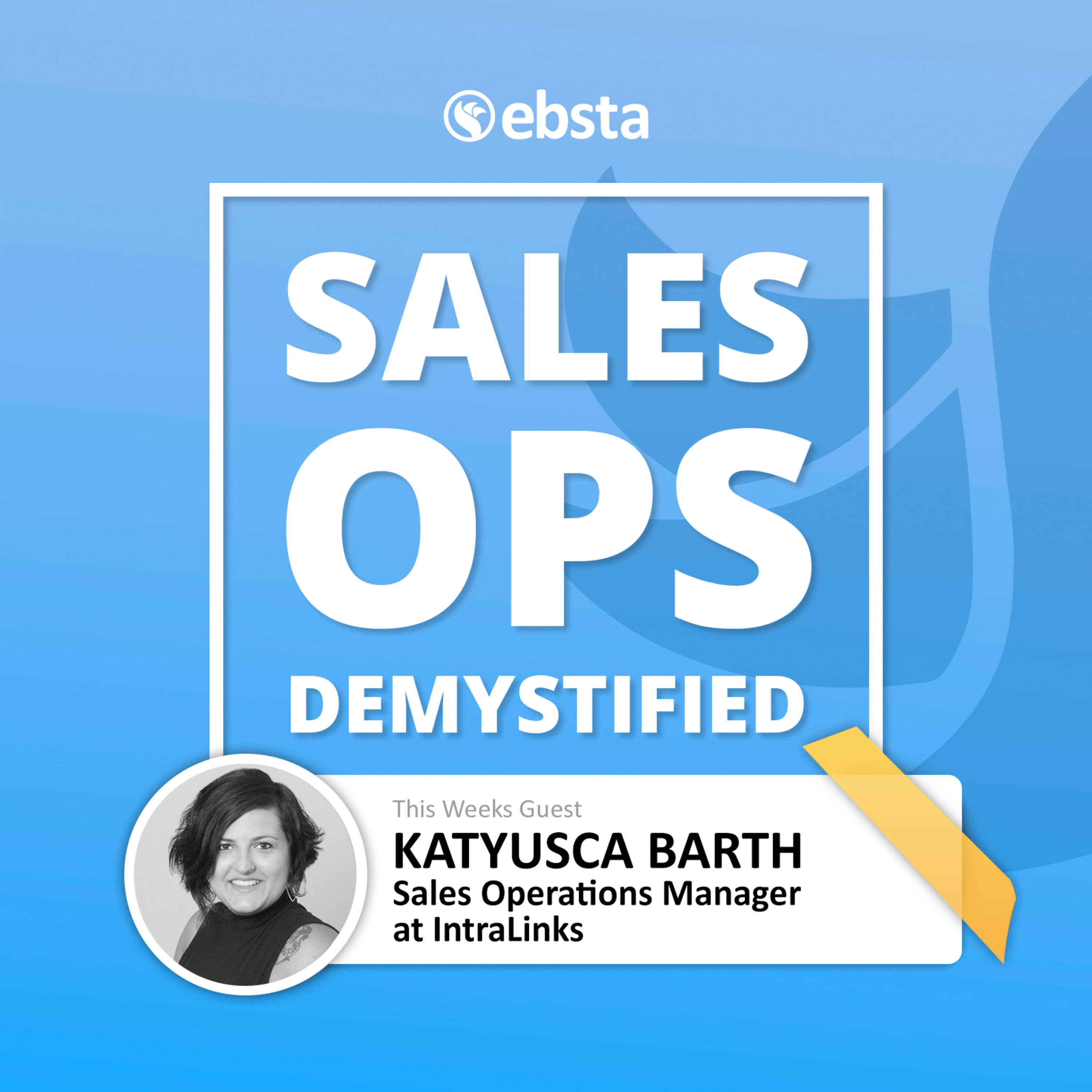
Inside Intralinks sales operations, with Katyusca Barth
Katyusca Barth, Sales Operations Manager at Intralinks, on building a career and succeeding in a sales operations role, on the Revenue Insights Podcast.
- A view into the sales operations function at Intralinks.
Peripheral to the product, but a window into how Intralinks runs commercially.
Have you ever wondered how your sales performance compares against your competitors and peers?
The B2B Sales Benchmark Report provides the definitive guide to what success looks like in 2021.
See how you compare in terms of win rate, sales cycle, average, deal value, relationships, and engagement.
You can see the results and get the full report at ebster.
com forward slash b2b dash sales dash benchmarks.
.
This is Sales Ops Demystified, the number one most downloaded podcast in sales operations.
We invite the brightest minds in sales operations onto the show to deconstruct the why, what, and how behind rep productivity, forecasting, , and all things revenue.
This podcast is brought to you by Ebster, the leading customer engagement platform for Salesforce.
Welcome to another episode of Sales Optimified.
.
Hello.
Hello.
Hello.
Hello.
Hello.
Hello.
Hello.
Hello.
Hello.
Hello.
Hello.
Hello.
Hello.
Hello.
Hello.
Hello.
Hello.
Hello.
Hello.
Hello.
Hello.
Hello.
Hello.
Hello.
Hello.
Hello.
Hello.
Hello.
Hello.
Hello.
Hello.
Hello.
Hello.
Hello.
Hello.
Hello.
Hello.
Hello.
Hello.
Hello.
Hello.
Hello.
Hello.
Hello.
Hello.
Hello.
Hello.
Hello.
Hello.
Hello.
Hello.
Hello.
Hello.
Hello.
Hello.
Hello.
Hello.
Hello.
Hello.
Hello.
Hello.
Hello.
Hello.
Hello.
Hello.
Hello.
Hello.
Hello.
Hello.
Hello.
Hello.
Hello.
Hello.
Hello.
Hello.
Hello.
Hello.
Hello.
Hello.
Hello.
Hello.
Hello.
Hello.
Hello.
Hello.
Hello.
Hello.
Hello.
Hello.
Hello.
Hello.
Hello.
Hello.
Hello.
Hello.
Hello.
Hello.
Hello.
Hello.
Hello.
Hello.
Hello.
Hello.
Hello.
Hello.
Hello.
Hello.
Hello.
Hello.
Hello .
So in different markets as well, because you used to live and work in Brazil.
Yep, exactly.
Fantastic.
Awesome.
Kajitka, welcome to the show and let's kick off.
Question number one, how did you get into sales ops?
It's a good one.
I actually, so as you said, I grew up in Brazil.
So we start working quite early there.
I was 15 and I was doing code calling.
15?
Yeah.
Wow.
I was doing code calling for a telecom company.
We were a very small office focused on BMEs.
And after a while there, the supervisor left.
And I started doing graphs and reports.
And all of a sudden, I was helping design our Java-based.
.
That was quite interesting.
So that was like a long, long time ago.
Was that when you were 15?
Yeah, I was 17 by then.
So would you say that you were active in sales operations since you were 17 years old?
That's correct.
So you've got to be the youngest or the earliest starting sales.
I was a very odd teenager.
Yes, I was a very odd.
I really liked spreadsheets.
.
Surely you had, sorry, another question on that.
Surely you had cold call, either targets for calls or targets for sales.
Were you doing that in your spare time?
How did you fit in that work?
Yeah, it was kind of, I started as an internship, like a high school internship kind of thing.
So I was doing it for, it was part-time at the afternoon and then I went to university.
I was doing marketing at the time and I started doing it.
.
Yeah, then I moved.
I decided to leave marketing.
It wasn't for me.
I decided to go to Sao Paulo.
So I moved to Sao Paulo, started studying international relations, and I got my first proper corporate job at DHL.
I'm going to skip the part that I was packaging boxes in the press center, and I'm going to go straight to the inside sales one.
.
So I was in an inside sales position for a year or so.
And this crazy guy, sales director at the time, said to me, I think you would be good at sales operations.
And even though I had that experience before, I wasn't really aware that that was what we was really.
So I went in a little bit blind and I kind of then really figured out one month.
and the CRM left admin and I had to figure out Siebel kind of on my own yeah so that then then the proper like big sales ops job started I was I went to sales enablement for a while that was about the time that I kind of decided to move to leave DHL and funnily enough a old client of mine from the Express Center talked to me about this company and had no idea what SaaS was.
M&A market was, my knowledge of M&A market was close to zero, zero data rooms, nothing.
But I did no sales, right?
Sales processes, the team there in Brazil gave me a lot of freedom to be creative and change processes and risk some stuff.
That led me to move to Boston to our headquarters in a deal desk.
position, then that led me to London.
And for a year I was doing, I was a BA in our corporate system solutions team.
And then this guy, this crazy French guy, Laurent Soltan, our SVP of sales in EMEA, thought that it would be a good idea for me to lead the sales ops team.
And here we are.
Here we go.
So right now, how many people are in the sales ops team?
.
In my team, I have two amazing analysts, Scott and Christina.
Shout out to Scott and Christina if they're watching.
Yes.
And globally, we have about 10 people in the team, like straight sales operations, sales enablements, a big auto group.
So we have quite an extensive sales excellence team led by our amazing Wayne.
Okay, cool.
So you're leading the global sales ops team.
The EMEA sales ops.
Okay, cool.
And there's around 10 in sales ops globally.
Yeah.
Got it, cool.
And how many sales people are the EMEA team responsible for?
We have, all in all, it's about 80 people in the sales organization.
So there's an 80.
They're the ratio of three to 80.
I should actually, what I should do with every guest, I should get that ratio and we should try and work out.
Yeah.
.
So your journey, I guess, ever since you're 17, you've essentially been doing sales ops stuff, right?
And then that experience helped you kind of move into that role more formally later in the career.
Cool.
Correct.
Great.
Yeah.
Okay.
So what do you think makes an awesome sales ops person?
Yeah.
I was thinking about that before this.
I think for me, it comes down to the right balance between analytics.
and business mindset and business acumen.
I feel that if you have only the analytics part, you're not going to be as successful.
You need to understand the clients.
You need to understand what it takes to win a deal.
Otherwise, the process you build and the reports you make will not connect with the team.
And you will not add value if you don't really understand what's going on with the business.
and that deep understanding of the business.
Cool.
So that's more, I think that we've had this before where you really need to get into the numbers, but then you also need to see the bigger picture, like the strategy.
Cool.
And so do you have any like tips on how you like how to do that?
Or is it just something you get used to?
Yeah, I was lucky that my journey kind of allowed me to do that because I was, I had like sales jobs.
in between but I also has always been very curious I've always been very curious so even if it's something that I don't so when I when I moved to Boston and doing deal desk I there was part of our business that we didn't have in Latin America because our market was just like smaller and didn't really have the need for it so I jumped in I sat down with the sales guys I was listening to calls to understand that entire line of business that I It's about being curious.
You don't have to do it yourself, but you need to be curious about it and really understand it.
Yeah, I kind of find that with marketing as well.
You're kind of the marketing team.
Stay away from the sales conversations and you think you know what the customer's like or what the prospects want, but actually you never really know unless you sit in the conversations.
So I guess it's the same with sales, right?
Exactly, exactly.
I feel very strong.
about that.
I really need to be connected to the team and understand what's going on in front of clients.
So do you mandate that your analysts go and fit on sales calls, for example?
Oh, yeah.
I ask them to do that.
I ask them to be on the QBRs with them and understand how they're approaching their territories and really be in client meetings, if possible, at least once in a while.
the other day, but at least once a quarter, if possible, go to a client event, talk to some clients.
And yeah, I definitely encourage them to do that.
Got it.
Do you think that sales experience is necessary for sales operations?
I sort of answered that.
I don't think it's necessary.
Like, I don't think it's a requirement to be a good sales operations professional to have been done sales before.
I do feel that you need to understand the sales team, the sales process very deeply in our clients how our clients make decisions this is crucial information for you to do a good job as a sales operations professional so i don't think you need that experience necessarily yourself but it's it's a married relationship for me you need to understand what's going on so so do you think that your sales experience has helped you oh yeah definitely definitely so okay then if i let's say me and i've had like a little bit I've had none.
And then I wanted to take on a sales ops role here at Ebster.
What would I do to kind of make sure that I understood the sales people or understood the process?
Like, well, what are the actual actions I would take?
Good question.
I obviously, like, would depend on, like, how mature it is and, like, what is exactly you need to take on in terms of building a sales operations.
But it's, like, literally it's just, I would, .
.
What is your current technology at Intralinks in the sales ops world?
Yeah, so we use Salesforce as our CRM.
We have quite a lot of applications in the ecosystem, like Zora.
I thought about mentioning Highspot, which is an interesting one.
Really cool tool for proposal and pitch and stuff.
Really cool.
We also use for internal communication with the sales team, etc.
.
From an analytics perspective, we use OBIE, and I float around with Power BI, which is something that I find very interesting for data visualization.
What about Power BI?
Power BI, yeah.
It's a Microsoft-based one, so everyone has it.
No one really uses it.
So I've been using it.
I'm really, really excited about the Tableau acquisition, by the way.
I'm like jumping out of my seat.
.
I think I'm really looking forward to see what Salesforce is going to come up with because Tableau is a really powerful tool.
And Power BI kind of mimics Tableau and has some features.
So I'm really excited about that acquisition.
When you heard it, did you literally jump out of your chair?
I literally just jumped out.
I was sending to my team, like, this is the biggest news of the year.
I was really excited about that.
.
Any others?
Well, we have Slack.
You asked me my favorite tool.
Right now, Slack is one of my favorites.
It's a really cool collaboration tool, fast communication.
It's really powerful tool for me in terms of collaboration.
Sorry, continue.
It's a time management tool.
I've been feeling the need to, like, it's been giving me a lot of perspective, like, to understand where the time is going, where I'm spending more time.
Oh, nice.
Yeah, so it's a really cool tool.
So that, like, runs on your computer, and then you can see at the end of the day, like, where you, if you're on, like, Facebook for, like, two minutes or...
No, it's actually, like, I insert it, so you can create projects or whatever it is that you want to track.
.
And then you enter the time.
So there's a timer option.
So I'm using that and it's been very interesting because I had a perception of, oh, this is taking too much time.
But just by doing this exercise, I realized that things that I don't necessarily perceive that it's taking a lot of time are the ones actually taking more of my time.
So it's a scary but interesting exercise.
.
Yeah.
So we are doing some pilots with outreach.
So a lot of Salesforce-based applications, really.
We try to empower them as much as possible.
Our transactional, which is the vast majority of our business, is quite hard to get in.
So we have to use different sources.
So it's hard to come up with a very automated tool, but we do our best to integrate as much as possible with the data available in the market.
So we have to do some maneuvers a little bit to make that happen.
Got it.
And favorite tech tool is Slack.
Yeah.
So what we've been doing yesterday is whenever a deal closes, .
Do you do that?
No, we do.
We do it more kind of organically.
We don't have necessarily integration.
We are using some integrated features in Slack, but we use AHA for innovation and stuff like that.
But we're creating that culture of sharing that information.
.
I find it very exciting and it's more approachable.
People can have information kind of on the spot.
I really like it.
Awesome.
How do you deal with data quality?
That's the question, isn't it?
Data quality is tough of mind for me.
It's definitely my top three priority this year especially.
.
I think, obviously, we're not the CRM admins ourselves, but we are a very important piece of the puzzle of the data quality.
So the way I see our role, me and my team, we're the ones looking at the data on a daily basis.
We're the ones closer to the field to really understand the data input, because that's the key for me, is understanding how the data is getting to the system.
And .
So I see my role as kind of this ambassador for the field, talking to the people who are making decisions in the configuration of the system so it's as friendly as possible so we can have quality data.
It's a challenge.
I was thinking about this question and I remember when I first, like my first CRM admin position, with Siebel, we had a huge adoption problem at the time.
Sales team didn't trust the system.
DHL had some pretty strong KPIs.
It was a very KPI-driven sales organization.
And people were arguing.
They didn't trust the KPIs, et cetera.
So because my immediate previous role was as an account executive myself, I used that experience.
.
I changed a bunch of stuff.
I made processes that didn't make sense and I remade them.
It was very laboral and took time, but we could really clearly see the results.
A year or so after, our territory planning process has improved significantly and the level of discussions that we had to have with the field about their QPIs reduced significantly.
.
It's top of mind.
To me, one of the most important things you can do as an organization is making sure that your data inputs and the people who are in the field talking to clients, it's as friendly as possible for them.
So you can have quality data to look at.
Otherwise, it's not going to make sense.
So you're essentially linking the sales team and the people, I assume they're in IT, who are managing all of the Salesforce admins.
I try to do that to the best of my .
Yeah, yeah.
Always easy.
Yeah, yeah.
So a salesperson, like, march up to IT and be like, change this field.
Exactly.
Yeah, okay.
And you're like, no, don't do that.
Come to me first.
Okay, cool.
So what would you say is your biggest challenge in the role?
I think right now one of my biggest challenges, and I don't think I'm alone on that one, is obviously Interlinks is a global organization, but our mothership is in the U.
S.
.
So a lot of the processes are, it's natural that the processes are created based on that U.
S.
experience, which doesn't necessarily always apply to the complexity of the EMEA markets, right?
So this is definitely one of my biggest challenges now, making sure that what we are consuming makes sense to our markets.
So I try to build a relationship that I made when I was in the U.
S.
and I keep those relationships going, like knowing the right people, talking to them regularly to make sure that I'm on top of what's coming.
So I can influence the decision a little bit and, hey, this might not work for this and this situation or this market or this currency.
So I try to do that to the best of my ability.
That's definitely a challenge.
And I think it's a natural thing.
It's never going to go away entirely, .
So our team here has some quality work delivered to them.
Yeah.
So you're saying that the challenge of managing the relationships with your American stakeholders.
Yeah.
Yeah.
Making those decisions.
Yeah.
Helping make those decisions and influence those decisions.
It's the challenge.
Do you like go over there like every year for like team events?
Yeah.
I try to go, but I don't wait to go there.
I have regular one-on-one with people.
I keep them on the loop.
I try to talk to people as much as possible so I know what's going on.
Yeah, I think...
I don't want to be horrible to Americans.
I don't want to be prejudiced, but maybe they wouldn't understand.
.
I honestly don't think it's in a malicious way.
It's hard when you're in the day-to-day trying to get stuff done.
You're going to talk to the person right next to you.
.
Yes, definitely.
Metrics.
Do you have a single metric that you can judge all sales users by?
I don't believe so.
.
No, I don't think there is one single metric.
Obviously, it depends on what industry you're in and how complex is your sales cycle.
You kind of have more or less.
I think metrics are a crucial, critical indicator for us.
I think we would go blind if we didn't have them.
But I don't think that it's all there is.
I think they always have less, not so easily measurable elements.
with people, with people that are talking about clients.
It's not a all black and white thing.
I think if you spend way too many hours with your numbers and your spreadsheets and your trend lines, you lose perspective of the people and the clients and what's going on.
So don't get me wrong, I'm a big fan of metrics.
I love them.
I try to get them standardized as much as possible, as simplified as possible so people can .
But I think you need to also be mindful of the people element and keep perspective.
Otherwise, the numbers don't tell the whole story.
Never.
Interesting perspective, actually.
We haven't had that before.
But okay, I'm going to push on this.
Right now, at your business, if you could only use one metric to judge the reps, what would you choose?
.
One metric.
I would say.
I cannot make up my mind on that one.
What are the options?
I would say definitely.
People they are talking to.
Coverage of the territory.
Especially for the key accounts.
.
I think we're finding that being more targeted and more specific about who we are talking to is being much more effective than trying to cover everything.
So being more strategic about your territory, I would say that would be one of the key metrics for me.
So we're building a lot of some dashboards around key accounts, crucial people to talk to.
.
Awesome.
Okay.
and final question, who taught you the most about sales operations or who's inspired you?
You mentioned quite a few people at the start.
Yeah, I do.
I have to mention two people, two very important people.
So, Josue Estrada was the sales director who first, like, told me that I would be good at this.
And he not only said that, he literally, like, spent time with me going over teaching me how to put a report together.
It took like, he didn't have to do it.
I was a junior analyst.
He was the director, you know, and he did that.
Yeah.
Yeah.
He's currently, he's currently San Francisco at Salesforce.
And I saw him a couple of weeks, a couple of years ago.
He's, he's always going to inspire me.
He's an amazing guy.
And I wouldn't be where I am.
If it wasn't for that, that moment where it's, he said, Hey, maybe we should do it.
.
And I need to mention my pal, my mentor, Greg Hattrick.
He's our amazing corporate systems director.
He is such an innovator.
He can make sense of really complex processes and make them easier to understand and connect the dots that no one will.
.
But every day I learn from him.
I keep telling him to move to London, but he won't.
Is he in the US?
In Boston, yeah.
He should definitely come over.
I know, yeah.
Definitely, like, it's a constant learning experience and having this.
He's not in sales operations, by the way.
But he has this process-oriented mentality and he can make sense of things.
And that, to me, .
It's a crucial skill set for what we do to be able to see and anticipate issues.
So I'm constantly learning from him, and it's a really good thing to have.
Fantastic.
Okay.
To summarize things I picked out, there's the analytical versus the strategic mindset that you need in self-operations.
There's try not to focus too much on numbers because you're losing .
Thank you so much for inviting me.
at Ebster.
at ebster.
com with tomhunt at ebster.
com.
Auto-generated transcript, may contain errors. Listen to the original to confirm wording.
Summary and analysis by VirtualData-Room.com from the public episode. Play it above; the original source is linked there.