



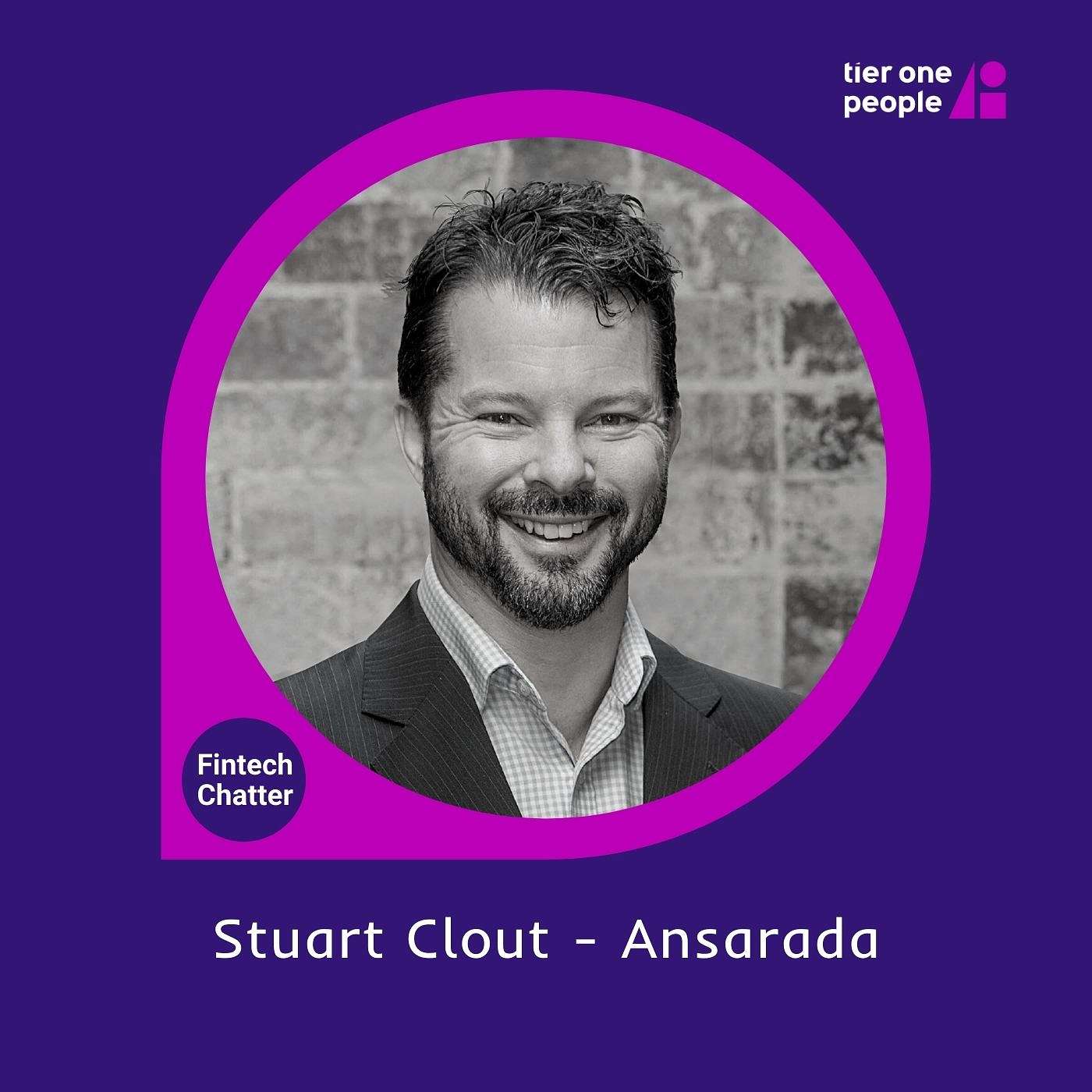
Fintech Chatter: Stuart Clout, co-founder and CRO of Ansarada
Ansarada Group co-founder and Chief Revenue Officer Stuart Clout on the merger of theDocyard with Ansarada and the year that followed.
- The merger of theDocyard with Ansarada.
- Ansarada's revenue strategy from its CRO.
Context on the merger that shaped today's Ansarada Group.
Welcome back to another episode of Fintech Chatter.
I'm Dexter Cousins, your host and the founder of Tier 1 People, where for the past decade, I've been helping founders like today's guest identify and hire exceptional leaders.
I'm talking about the 1% who can help you redefine what's possible for your business.
2026 is shaping up to be a bumper year in fintech.
So if you're thinking about hiring in this next six months, now is the time for us to talk.
There's a link in the show notes where You can reach out to me direct.
And just a quick thanks for your support.
If you are new to the show, make sure you like and subscribe.
And if you're listening on podcast, give us a follow so you never miss another episode.
Now, on to today's guest.
This is FinTech Chatter, presented by Tier 1 People, leaders in FinTech executive search.
And I'm your host, Dexter Cousins.
in episode 81.
I'm joined by Stuart Clout, Chief Revenue Officer and Co-Founder of Ansarada Group.
This is Stuart's second time on the show.
He first appeared in episode 4 when we talked about his business, The Dockyard.
It's been an incredible 14 months since then, and Stuart shares the audacious merger of The Dockyard with Ansarada and how by bringing the companies together, to create another Aussie fintech unicorn.
Stuart, welcome back to the show.
G'day Dexter, great to be back.
Yeah, so you were podcast 1 BC, so that was the last podcast we ever did before COVID hit.
I think it was 13 months ago.
I mean, what an incredible period we've been through, eh?
.
Yeah, and that's like at a global level, yes, and still going through.
Like, obviously, you'll still see the news every day, right?
But also, from a business perspective, you know, it's been really interesting.
There's been some people that have, you know, COVID has helped their business and, you know, brought their business to the fore, particularly, you know, I guess technology, collaboration, all that kind of stuff.
And, yeah, it's been a pretty big year for me personally with the Dockyard.
.
Awesome.
Well, look, I wondered if you could tell our listeners a little bit about Ansarata and maybe a little bit of the back story too.
Yeah.
So the Ansarata group is the coming together of the original Ansarata business.
There's been Sam Riley and Rachel Riley and Andrew Saban formed a little over 15 years ago in Sydney.
with the company that I founded four or five years ago, which is the Dockyard, and the Athena board business as well, which we at the Dockyard acquired, and that was Steve Engel and his business.
And we've brought them all together to form a broader information governance platform where we're going to market with a whole new suite of products.
So we took advantage of 2020 as much as we couldn't get out of Australia, so we brought three great Australian companies together.
.
So what's the big problem that you solve?
So I describe it like this.
Your most critical data in your most critical moments.
And we look after that for you.
So the Dockyard and Ansarata in particular had their heritage or their genesis in transactions.
So capital raises, IPOs, M&A type stuff.
And they're critical moments and there's a lot of critical data.
that information, being able to control the information, being able to audit and track who's looking at it and manage that whole process.
And the Dockyard, with my background, originally being a capital markets advisor in project management and workflow of these critical events known as a transaction.
And Steve and his business with Athena and the Athena board product, which is now Ansarata board, was managing and controlling critical information at a board meeting.
.
I used to be amazed at some of the stuff that I saw when we first started getting into the board portal game where directors would be FedExed ring binder folders with the board papers and left on the front porch for them to come home from work to pick up.
That's an extreme example of it.
But even just emailing critical information like board papers around and the lack of governance around that information is quite extraordinary.
So that's the genre or the market that we play in now is governance of critical information or as we call it, information governance platform.
So when we first had you on the show, I think none of us really kind of had any anticipation for, you know, the world that we're in now where pretty much, you know, the whole workforce is still working remotely.
What's, you know, what now has changed?
to make your solution even more important.
So, yeah, there's two things actually that come to mind with that.
One I'll talk about, I'll answer your actual question next to it, which makes our solution more important.
But I'll also give an observation about something I've noticed has changed generally in business, which some people might be interested in as well.
So, the first part is, you know, we're a technology that allows people to get work done when they're not together.
And, you know, I guess is the virtualization of the workforce and the virtualization of our work has really played to the already existing strengths in our business set.
So to take that from esoteric into real life, what's an example of that?
An example of that is a cross-border mergers and acquisitions transaction.
And let's say the party buying and the party selling are in different places, therefore their lawyers and their bankers and their accountants, they're all in .
people to drive and work virtually 24-7.
And you're not waiting for a phone call or waiting for an email response that people will work collaboratively and live in our technologies.
And whether that's sharing information, managing tasks, ensuring that things are staying on track, reporting to clients, all that kind of stuff.
And for us, I guess the acceptance, and this is the second part of my thought, the acceptance of working remotely now has just gone through the roof.
.
.
You needed to get some washing done or you had a dentist appointment, but you're going to just pretend to work from home for the day.
But this is gone, right?
This is just blown up.
Everyone's like, we just didn't trust ourselves and everyone else enough.
And I mean, I'm predominantly now after the merger, I stepped back as I was the CEO of one of the merged entities.
And I now am the chief revenue officer and global head of growth.
and the market side of our business.
And you would remember, Dexter, to say a couple of years ago even that sales teams don't have to go and see their clients, that sales people can just do it by Teams or Zoom or whatever.
People would be like, nah, nah, sales, you've got to go and see someone, you've got to sit down with someone, you've got to have a cup of tea with them or a cup of coffee with them or maybe even a beer.
But the virtualization and the trust and the efficiency that actually you can get has gone through the roof and you know we're seeing here with our sales guys they're able to do you know so many more deeper interactions with the client because they can have a face-to-face you know virtually meeting with someone and everyone just gets on with it now i don't have to travel around all the different offices and that's been that gives you more reach like i don't have to be in oklahoma to actually have a good and acceptable sales meeting with someone from oklahoma like it's um whereas you know .
So maybe a couple of years ago, do you reckon that people would have thought, if the person's only going to Skype me, it's like a second-rate meeting, like they haven't taken it seriously enough to come and see me?
And I kind of feel like that's all just disappeared.
Yeah.
So you've hit kind of a really valid point, which is, I think, just around the acceptance and the changing of work practices and behaviours.
I think one of the other great things that I loved about when I first met with you in the solution, and this came to the fore as well as soon as COVID hit, is the legacy systems that you got sitting in banks, financial institutions, law firms, weren't geared up to deal with remote working either.
Yeah.
And a lot of organizations scrambled when all of a sudden, you know, government, the government might say, okay, you're going to shut all your offices down.
Everyone has to go from home tomorrow.
You know, for us at Ansarata, it was no big deal.
We were like, oh yeah, okay, we can do that.
And it was literally like, you know, check a few things, but you know, all of our systems are cloud-based.
Everything is completely , you know, we can do remote working standing on our heads.
And that's certainly what we experienced.
Now, we weren't completely unique in that.
There's tons and tons and tons of companies and businesses out there that found the transition to this really easy.
That's because they didn't have these big old legacy systems.
But certainly the organizations that, I guess, have that legacy, it was far, far more difficult.
And it's interesting, right?
Now, naturally, I would say this because I'm a guy who, , you know, runs a technology company in information governance.
But we see this whole trend of virtual working, working remotely, working from wherever.
At the core of it is actually governing your information because information is kind of like the lifeblood of every company.
And it's funny, right?
Like, I don't know if I had a manufacturing business, I have a factory and I have machinery and I'd have a fleet of trucks, but they're all assets, right?
And they typically sit on my balance sheet and I would do things to look after those assets.
.
Information is a core, if not arguably the most important asset that any organization has.
And what do people do to protect it?
What's their security system or their fire suppression system?
.
How well is that information being governed?
.
And, you know, you layer across that.
We've probably almost stopped talking about the Hayne Royal Commission.
But, you know, we talk about compliance and directors' understanding of compliance.
And we saw it in the commissioner said to some of the key executives of big four banks, do you know whether you are compliant with this piece of regulation?
And they were like, I'll have to come back and tell you tomorrow, next week.
.
And the compliance framework is there and it's in force and in power.
But actually the understanding of whether one is compliant with that stuff is super, super immature.
I reckon you could, here's a pop quiz, go and ask any director of an ASX listed company if you could walk down Bridge Street or Pet Street and run into them all.
And if you had to go like, , are you compliant with these five things that your business is meant to be compliant with?
I would question how many people would be able to honestly go, yeah, so we're good on that one.
We've got a couple of little controls left to fill for this, but these three were absolutely tickety-boo on.
I just don't think you would get that level of confidence and certainty in the answers because people don't know.
We see information governance as this whole area that is, well, I think it's already exploding, honestly, .
.
You got those three in a solution.
And as you pointed out, if you don't fix this, then the likelihood is you're potentially going to spend some time in jail or at least be standing in the dock in front of a judge and being very uncomfortable.
Then I'd have to agree with you, Stuart.
I think it is a market or a product that's about the Zoom.
Yeah, because if you think, like I always think about this in business, right?
is it more likely or less likely that organizations are going to have to be more on top of this stuff?
And if the answer is, yeah, I find it difficult to see how the world's organizations are not going to have to get better at this, then that means we're in the right game.
Because that means that as everyone has to get better at this, they're going to then have to find a tool to help them get better at this.
is, right?
In this instance, it's a tool.
It's a framework in which you can deliver that outcome for the business.
And that outcome is I'm compliant and I know I'm compliant and I can prove I'm compliant.
And that's the thing.
But I agree with you.
Governance, risk and compliance, collaboration and security of your data is the holy trinity.
And it's funny, like I listen to a different podcast other than obviously listen to yours as well, Dexter.
But I listen to a podcast on Wondery, is a pretty popular one, like heaps of people listen to that.
And it always tells the story of two businesses that we've all heard of.
And, you know, yes, McDonald's versus Burger King or Boeing versus Airbus or, you know, Nintendo versus Sony or whatever it is.
And it's always six or seven series little profiles of these companies and the story that they've got.
And the one thing that really stands out to me is that most companies that we all know and have heard of started doing something.
.
And there was something in what they started doing, which put them in a good position to actually understand a bigger or broader or different problem.
And, you know, they often will start here.
And I guess the cheese balls in startup land call it a pivot these days, you know, and they will pivot it into something else.
But I just kind of see it as a natural sort of evolution that they started doing one thing, but that positioned them really well to understand this other problem.
And with that, we really feel that at Ansarata.
.
So you look at Ansarata 15 years ago, the virtual data room is their core base product.
They've been known for a good 15 years around the world as the best virtual data room in terms of its compliance, its security, and its usability.
And at the core of the virtual data room, it's a very simple concept, is really securely keeping your data and stopping other people being able to extract it, tracking who's looking at it, being able to get it back, .
So we've got cool things like I might allow you to download a spreadsheet from the data room, which is my financial model because you need to see it so you can see whether you want to buy me or not.
And you can even save that on your desktop.
I can blow it up remotely from your desktop with Anserata.
So that's sort of some of the high-end features that we have.
So it allows you to control that data to get it back, to blow it up, to do all that kind of stuff.
And having that pedigree in helping .
, pretty much every company in the world, every fund, every bank, even government organizations, we now have a fantastic business in infrastructure tendering, where the Sydney Metro Project, which everyone is excited about here in Sydney, the tendering process is all done on Ansarata.
Now, why?
Because when the New South Wales state government has to expose really critical infrastructure information about the city of Sydney, to third-party tenderers so that they can come up with a response to, hey, pick us to drill your big tunnels underneath the harbour.
If you think about some of the information that Transport for New South Wales would have to expose, it would be, for example, you know, super secret plans about, you know, the infrastructure of the city.
And you don't want that getting into the hands of people who want to use that against you.
So being able to manage and control the disclosure of that information is really key.
But do you know what?
started doing virtual data rooms.
Did we think we'd be assisting governments control their critical infrastructure information for big PPP projects?
Like we didn't, but now we do.
And it's that, you know, where you start can position you well for where you go.
are now becoming enterprises are now becoming enterprises and as fintech goes mainstream many enterprises are reinventing themselves as fintechs tier one people proudly works with companies at the forefront of fintech innovation our clients include international fintech corporate ventures big tech tech platforms banks payment providers and financial institutions we're interested in talking to talent with expertise in merging fintech startups with banks , and those with expertise in transforming legacy financial services businesses into fintech.
If you'd like to be on our radar for these upcoming opportunities, go to info at tier1people.
com.
Cool.
Now, I want to give you a bit of kudos because when we did the first show, I think you just listed, and you had a really, you know, vision and some of the things that you've learned about it.
So I would really agree that there's probably there's too much homogeny with the perceived journey that a founder should be going on.
And it's almost like there's only one script and then everyone tries to just follow that script.
You know, it's like you said, like, come up with the idea, you know, leave job, found company, risk all.
, raise money, raise money, don't have heaps left of your own company that you started.
And then, and in some ways, hope that all comes together.
Right.
And there's so many moving parts in business, you know, and there's so many things that you can control, but there's also tons that you can't.
And so that's why the attrition rate for startups is, you know, famously, you know, horrible.
Right.
You know, I don't even know what the latest figures are, but, you know, 98% of startups or 95% of startups never make it.
.
And then the 5% that do make it.
Only half of them make it more than five years, et cetera.
You know, the attrition rate is off the scale.
So then when you look at that from a logical perspective, like you'd sit there and go, well, why would I follow that script?
Because the outcomes are minutely skewed against me, right?
Like the chances of me actually making it.
So it doesn't seem like that actually doesn't seem to me to be the smartest path to go down.
Now, I don't necessarily think that I had that level of clarity of thinking, .
Which is why, which dictated my path.
I think, you know, there is also an element of serendipity.
You know, you meet some people, they give you some ideas.
There's also just sometimes opportunities come up.
And so, for example, when Sam and I got together and, you know, we definitely is a merging of the businesses.
And that's certainly the way that we see it.
You know, no one bought the other.
It was we came together because the best bits of my business and the best bits of, you know, Sam's business can, you know, can be even better together.
.
And, you know, so sometimes it is a little oriented around some opportunities that can come up and be presented to you.
But I would massively, and this is something I want to spend heaps of time on when I've got more time, is I massively encourage founders to think about alternative paths.
And part of it, I think, is managing your own ego.
And, you know, sitting there going, do I have to be the sole founder that just lifted all of the weight and made it happen and became, the man or the woman, right?
Like founder that everyone looks up to, you know, because it's such a rare occurrence to occur.
And also what most people don't realize is when you look at, you know, even famous, I guess, entrepreneurs who, you know, one may look up to, their paths haven't been linear.
And in fact, there's a whole stack of stuff that occurs in the background, particularly around making acquisitions and doing mergers and partnering with people.
, you know, together, stronger type strategies, which actually get people there.
Like the path is littered with founders who just try and go the whole way, the whole distance themselves.
And I think the statistics show that that's actually not a very smart play because so few make it.
So why would you be doing that anyway?
And I think in a country like Australia where going to market is more difficult because our home market, whilst a sophisticated one, is a small one.
here, but grow elsewhere.
Yeah.
Is that, you know, going it alone is a pretty, pretty dangerous strategy.
And so I would always encourage founders to go, well, what are you doing it for?
Are you trying to prove you're the biggest hero in the world?
Because, I mean, if that's, if that's what's driving you, then sure.
Are you trying to create financial independence for your family?
Are you, you know, what's your driver?
And then does your strategy sync with what your actual true, is.
And that takes a whole ton of honesty, which, you know, sometimes it's funny, like being honest with yourself can actually be remarkably difficult.
You actually sit down and go, what actually am I trying to prove here?
What actually is driving me?
And if you can get that level of honesty with yourself, it can help you make better decisions, I reckon.
Yes.
Awesome advice.
I've been through that process myself and I can tell you that, you know, it's painful, right?
when you let the ego drive you to make those decisions and you know i recall you know times where looking at myself in the mirror and thinking you know you're putting your family at jeopardy and your future at jeopardy just to to satisfy your ego and it is it is very confronting but the liberty that you get on the other side of that and the freedom that you feel from hey i'm really comfortable with you know what the outcome is that we're looking for and having the plan accordingly .
I get asked all the time about, hey, what are you doing to scale your business?
And we would much prefer to help our clients scale their business and scale ours because we're just not comfortable with a business model of a recruitment business.
And here's the hard bit.
Don't get greedy.
Yeah.
That's the piece is don't get greedy.
And it's important, right?
Like, you know, I see, , I see some very odd decisions made in business and I look at it and I think that is driven by either greed and ego or a mix, a heady mix of the both.
And if that's what's driving your decision making, well, at least, at least if that is what's driving it, at least own that or be honest about it and then make any changes that you feel are right for you.
You know, it's not for me or you to tell anyone what to do, but certainly you don't have to.
The good thing about this is it's super private, right?
It can be just you in the mirror.
It could be, the moment before you're drifting off to sleep and you're lying in bed and you think, am I on track?
Am I happy with the reasons that are driving my decision-making?
But the don't-get-greedy one is something that you've got to, for me, I'll keep it in check.
Make sure you're managing that.
Make sure you've still got your eye on the real outcome that you're looking for.
So what's been some of the benefits of merging the three companies?
So people, people, people, basically.
.
You know, there's more people for me now because the Dockyard and Athena combination collectively was significantly smaller than the Yansarata business before we put them together.
So for us, it's been a big step up in terms of just the size of the organization, which means the resources and the talent that you have access to to do stuff and get stuff done has been phenomenal.
It's also helped us feel part of a bigger thing, .
aside, it's just more difficult.
You might be the CEO of the company, but you also empty the bins at the end of the day.
You make sure the windows are closed and the curtains are pulled.
You get in the morning and you're carrying in a new monitor from Officeworks because you've got a new start of that morning and you've had to go via Officeworks to buy the monitor because you didn't have one.
All the non-sexy, real-life parts of trying to grow a business.
I just think also, .
Well, I'm really focused in on sort of the origin story of many companies at the moment.
And, you know, the one that I love from one of my recent stories, which was the Starbucks Dunkin' Donuts Business Wars one, was that Starbucks never sold cups of coffee.
Like, that's hilarious, right?
Like, Starbucks was actually a wholesaler of coffee beans, and you couldn't even get a cup of coffee at Starbucks when Starbucks was a thing.
Starbucks had six stores, and they still only sold beans, not actually cups of coffee.
.
But the origin stories of companies that we're seeing out of the States, and it's worth people looking into them if they're interested in this GRC and information governance space.
There's companies like OneTrust, which are really doing great things in the governance risk and compliance space.
And they started off doing cookie management.
See how the cookies on your browser?
Cookie management.
That's what they did.
They did that for years.
Cookie management.
Now, there are $5 billion, $6 billion behemoths in the governance risk and compliance space.
And again, .
They were helping manage people's data and manage information and keep you compliant with policy and regulation.
Their origin story has positioned them well for this giant market.
The total addressable market for software alone in the GRC space is north of US$20 billion per annum and growing at a phenomenal rate.
That is companies all around the world spending 20 billion a year on software solutions to help them with their governance risk and compliance outcomes.
And we're not even scratching the surface because, again, I reckon you could walk around town and talk to most executives in most companies and go, what tech are you guys using to help you stay more compliant?
And I'm going to make up a number, make up a stat.
One in 100 will give you an answer and say, oh, we're using X, Y, Z on this issue here.
Safety culture is a great example.
, for example, of a great Australian company, and I would put them in the governance, risk, and compliance space because they're helping their customers stay compliant with occupational health and safety regulations.
It's another example of the genre proliferating where technology is helping businesses stay compliant, but it's still a very immature in the sense that it's immature as a market, not the solutions.
The solutions aren't immature, but the customer adoption is just so early , it's kind of like it's before they discovered gold in California, right?
It's such an exciting space to be in.
I think it's just going to get bigger and bigger.
And Australia is very well placed, actually, to produce some of the world's leading GRC companies.
And the reason for that is that the Australian regulatory regime is considered best in class.
So we're significantly advanced as a jurisdiction when it comes to understanding governance and risk and compliance, because we're actually considered for big government spend.
So countries all over the world send their government representatives out to Australia to see how we do tendering for big public money.
.
and it's mind-blowing what people have to now contemplate with.
It's no longer the audit are going through with their checklist and ticking things off.
Yeah, and I reckon, I don't know what you reckon, Dexter, but I reckon most people who are in roles where they're actually ultimately responsible or accountable for governance and compliance, and so you're talking about directors on boards and that kind of thing, stuff, I reckon there's a lot of people walking around with their fingers in their ears going la la la la la, because they just don't want to know.
Metaphorically speaking, obviously, but there's a lot of ostriches with their heads in the sand.
Again, it comes to that point of when you look at a market to be in, and if you're an investor, you'd be thinking this way, right?
You go, well, is this market going to get bigger or smaller, or is it going to stay the same?
, it doesn't matter how many different angles I look at this, I just can't see how the globe's organizations, and again, that's not just companies, but there's a few of those around, companies, advisors, banks, governments, funds, every single organization in the world is going to have to get better at this.
And none of them are very good at it at the moment.
So that tells me one thing, which is this is a boom industry, and tech is the only way that it can be solved.
.
Absolutely.
Well, Stuart, it's been really good to have you on the show.
What can we expect from you in the next 12 months?
Well, given the last 12 months, then probably quite a lot.
So we've got some pretty exciting stuff happening here at Ansarata.
So tomorrow, which is, given this is recorded, today's the 3rd of May.
May the 4th be with you.
May the 4th be with you tomorrow, Star Wars Day.
.
So we officially launched Ansarata Deals.
Awesome.
Ansarata Deals is the combination of the project management and workflow tools from the Dockyard suite of solutions together with Ansarata's AI-driven leading virtual data room.
And we're putting them together and creating the world's most advanced transaction management solution.
And it is live this morning.
And all of our marketing goes big tomorrow on May the 4th.
.
We'll be taking over a lot of the main financial papers and digital space and absolutely plastering the globe green when it comes to helping them understand that there is an even better way for them to run their deals.
So we're super excited about that.
Our board technology is also wrapped into the platform.
So every company that's touching our technology when they're doing a transaction is going to be getting exposed to our board technology as well.
So there's a lot happening on our side this year.
story in the space.
Yeah, thanks, Dexter.
And it's always good to talk to you.
I can't wait to talk in another 12 months and we'll see where we're at then.
Yeah, fantastic.
And where can people find out more about Ansarada, Stuart?
Well, ansarada.
com is the best place to go.
So A-N-S-A-R-A-D-A.
com.
We've got a lot of executives that listen to the show.
If they're having sleepless nights around GRC, how do they get in touch with you?
.
So the best is probably just drop me a line on my email, which is stuart.
cloud at anserata.
com.
And I'll make sure that they will be sleeping easy for the rest of the year.
.
and the results are the results.
Auto-generated transcript, may contain errors. Listen to the original to confirm wording.
Summary and analysis by VirtualData-Room.com from the public episode. Play it above; the original source is linked there.